It depends, however in this instance, the problem in question was at the time my hardest first ascent.
Madeleine eats cake, 8A, was a coastal boulder, the rock was shale and it faced out to the Atlantic at Godrevey in Cornwall.
Some photos appeared on FB recently and appeared to show a large rock fall above and in the area called the bowling alley. Initially and I was not the only person to think this we thought the wall that contains the best and hardest problems was untouched, albeit a bit buried. After a visit by a local climber (I live in France now so couldn’t visit) it was confirmed that the whole wall had in fact collapsed. Below before and after photos.


I had mixed emotions, someone on FB pointed out there were plenty more rocks to climb etc. etc. For me this misses the point; I had spent a lot of time on this wall. I first went there in the late 1990’s, pre bouldering mats, with a bit of old yellow karrimat flapping around in the wind, weighted with stones, a towel or a beer mat to keep my feet clean. At this time the only problem that existed on the steep face in the bowling alley was the ‘crimp problem’, this involved two crimps to a slot and then a jug, I think at the time it was given 6c uk tech.1
I wrote several years ago…”Climbing down into the ‘bowling alley’, the personal history of the place strikes me. I have been coming down here for years and this current project is the culmination of all that time. Le Temp Passé, aka LTP, seemed a pretentious name at the time, now it seemed prescient. Back in 2002 I was adding a lower start to the existing problem, starting in the triangular pocket and moving left onto the crimps of the original problem; I gave this a grade of 7B. In Feb 2015 I started this problem a little to the left, doing a move before putting my right foot up onto the triangular pocket, this avoids the pocket as starting handhold, which is good because its often wet. It also seemed like an independent line as it starts further left and goes straight up the wall finishing high. I called this ‘Madeleine’ and gave it 7B+, though it might be harder, possibly 7C. This then opened up starting a hold lower and moving into Madeleine. I had only ever looked at this start as a fantasy; yet, it became a reality in a shockingly fast manner. In January 2015, I pulled on and stayed on. If I could pull on, I should be able to move, it was a revelation. So this leaves me with a project that is now very possible, albeit one that destroys my skin and has holds so small it takes a real effort of will to try the thing”
From a phenomenological perspective, Merleau-Ponty describes a moment such as the one described above as being:
between the see-er and the visible, between touching and touched, between one eye and the other, between hand and hand a kind of crossover occurs, when the spark of the sensing/sensible is lit, when the fire starts to burn that will not cease until some accident befalls the body, undoing what no accident would have sufficed to do…’[1]
For me meanwhile I wait for the confluence of tide, wind and a feeling of lightness and desire.
Then in May 2015, on a windy cold day with brilliant conditions I pulled on and moved my right hand towards the next hold. This point on the potential lowest start had become a reality. Many goes later, on a breezy coolish day, I pulled on, stuck the first move, the second and so familiar with the rest of the problem found myself at the jug, fuck! fuck!, I’d done it. I gave it 7C, then after a couple of years and no repeats, I listed it on UKC at 8A. Bit reluctantly as I did not want a downgrade.
After several years there had been no repeats, a few attempt by some strong folk and then in 2020 a mate texted me and said Solomon Kemball has flashed it. I thought oh no, here comes the embarrassing down grade, but after a flurry of FB exchanges it was established that 8A was fair, this is from the few that had tried it and I found out Solly was quite capable of flashing basic 8A, so I felt happy.
So you see there is quite a bit of me invested in that wall one way or another. I wonder what if it had fallen down before a repeat, I thought well at least it couldn’t be downgraded. I care about the grade, because it was a big deal for me, I did this problem in my early 50’s and I had grown to this age with the mythical 8A, slowly creeping towards me, dosed with a realistic understanding that it would probably never happen. I knew I was capable at the time; it was just that Cornwall had no problems of this grade then and travelling to boulder at your limit is never easy.
Anyhow to cut a long section short, I did not buy a moon 8A t-shirt, but I could have done. I am too old for that now.
Therefore, what happens when your boulder problem falls down?
I felt a bit sad, I felt a bit stupid, to have spent so much time under this wall, so much time, brushing holds, failing to do a move. It all seemed too pointless. Then I thought well it still exists doesn’t it? It exists for me sitting in France as much as it did before it fell down. All the experiences, the hours alone, the hours with friends, strangers that turned up, those things stay. The seal that always seemed to appear at the end of the point when I was there, I used to talk to it. I carried my son down the steep path, down the cliff, when the tide was too high to cross from below; I carried my small dog Sparrow down the same path a few years later. I loved that little path, as it secretly and shyly drops of from the main coast path. You would get the weird looks as you launched your boulder mat of the top, occasionally chatting with a bemused beach goer that had strayed round from the main beach. Even with the summer crowds, the essential feeling was of quiet. In winter, storms would change the landscape, swell and wind, the smell of salt and seaweed, sun and clouds. I miss that as I sit on the edge of the Pyrenees.
Those experiences are so intrinsically linked to the boulder problems as to be inseparable. The passage of experience as we boulder and become intimate with place and rock, is within the same stream of experience that sees me walk to look out to sea, to feel yellow lichen on the rock, to kick away some stinking seaweed, to clap my hands to attract the seal. So familiar, and so close still, even after years away. This is why I feel sad; this is why I am sad my boulder problem has fallen in the sea. The passage of time for that place, for that time has indeed passed. Leaving only memory and of course it is within memory for things lost that we can mourn, albeit with the proportion appropriate for a small piece of rock.
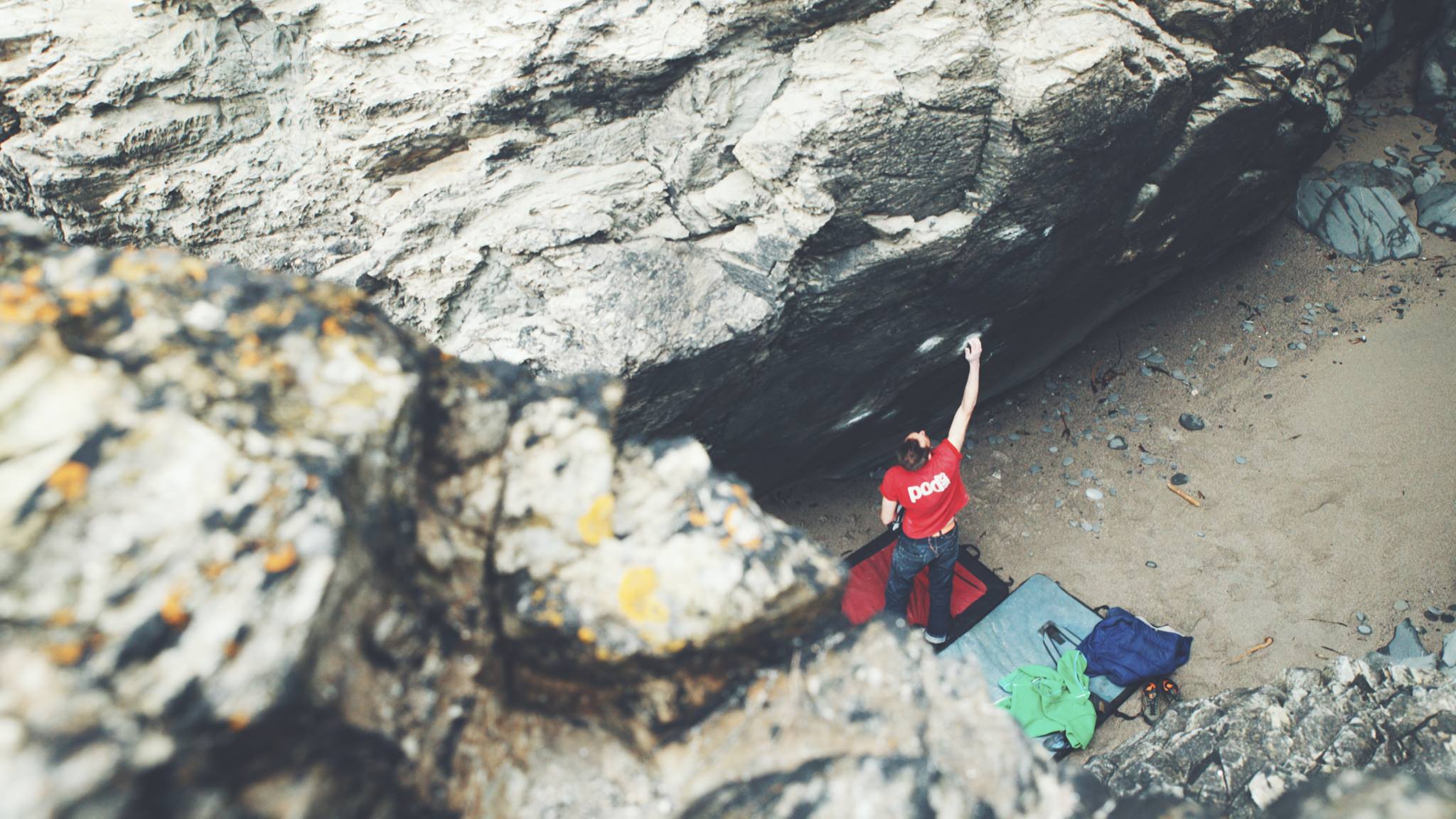
Le temps passe, this is what rather pretentiously at the time I called the problem, fuelled by a mild Francophile tendency and a handful of French existential novels I may have been reading at the time, and of course the Madeleine reference is clear enough, Proust and all that. Portentous maybe, geological karma, most definitely revealing the indifference of rock and wave to any of my material attachments. The falling down, signals what I could see as my true physical material relationship with other matter. My memories and sadness my conscious and ultimately meaningful relationship with the boulder problem. Materially gone forever, existing only in bodily memory.
[1] Maurice, Merleau-Ponty, Eye and Mind, Merleau-Ponty’s ‘Essays on Painting’, The Merleau-Ponty Aesthetics Reader, Ed, Galen A, Johnson, USA, North Western University, 1993, p.125.
 andywhall.com