Introduction
It begins or occurs often imperceptibly, with or in a space initially barely noticed: a den hidden beneath brambles, a boulder tucked into the curve of a slope, hidden from sight, a blank canvas resting against the russet coloured walls of my cabin in the evening light. One does not begin with construction or execution. One begins with, what? It’s impossible to describe because it is in time and part of time, however let’s call it attentive perception and what takes place is with imagination, with the slow, almost imperceptible act of dwelling.
The child’s den is first a whisper of shelter; the boulder line exists in anticipation before any chalk touches its surface; the painter’s subject emerges gradually, through gaze and contemplation, before the first brushstroke. In these moments, the world discloses itself quietly, awaiting engagement rather than demanding it. Martin Heidegger reminds us that we dwell before we build: “We do not dwell because we have built, but we build and have built because we dwell.” Heidegger’s formulation is useful here not as an ethical model, but as a way of naming a priority of experience that can be taken up critically and reworked.
Field Observation: The Escarpment
I climbed a steep, clay slope, the fallen leaves of years and the recent autumn pressed underfoot. The path followed the sandstone escarpment, revealing the folded upper layers of rock, buckled and faulted by forces ancient. The ridge is cut on a north to south axis, by post glacial rivers, exposing the layers of predominantly folded limestone and the relatively younger sandstones on top.
As the path levelled, stunted oaks and sparse conifers appeared, marking the subtle shift of microclimate: north-facing shade giving way to sunlit, south-facing slopes, Mediterranean shrubs brushing at the ankles. Framing the horizon, the snow-capped Pic de Soularac seemed at once remote and intimately present. A solitary holly bush, bereft of berries, stood by the trail, a reminder that the passage of time leaves its gentle, inevitable traces; earlier in the autumn the bush held five berries.
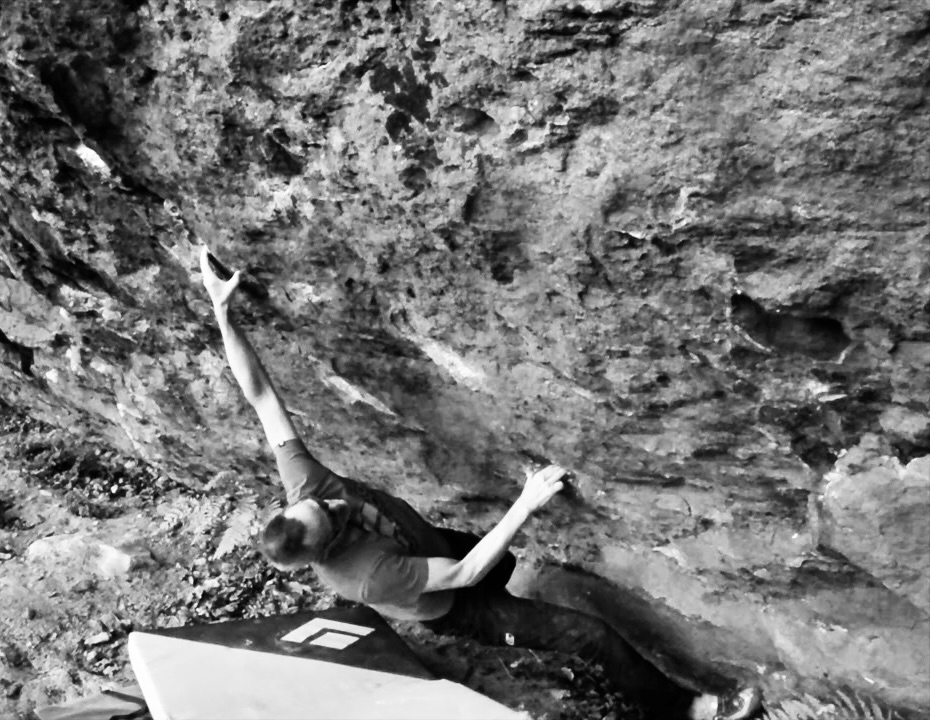
The rock itself rose as an overhang, south-facing, golden-red in the late afternoon light. Its base was flat, a denuded fin of eroded sandstone, punctuated by animal holes, traces of animal shelter. One could imagine both the human and animal body here, sleeping or sheltering, as if the rock itself invited quiet occupation. The angle kept it dry; the space persisted between permanence and impermanence, between potential and actual engagement.
Gaze, Imagination, and Dwelling
Before hands intervene, before climbing begins, before the first brushstroke, the gaze lingers. The boulder, the den, the canvas are initially possibilities, not objects. The child imagines the den, shaping it in thought before shaping it in matter; the climber anticipates movement along the rock as if rehearsing the body’s trajectory in advance; the painter inhabits the landscape perceptually before pigment meets canvas. In each instance, dwelling precedes doing, and imagination is the medium through which presence first registers.
The inhabitation (if we can forgive the neologism) occurs between the body, mind, and imagination in a process that owes more to circularity, interaction, and dynamism than to any linear sequence.
Maurice Merleau-Ponty reminds us that perception is embodied. One does not simply see the boulder, the den, the canvas; one lives them, anticipates them bodily, and lets them enter consciousness through touch, movement, and attention. Time stretches between perception and action, allowing the object to disclose itself gradually, fully present yet not yet possessed.
What matters here is not yet building, climbing, or painting. The first act is looking. The rock is encountered as possibility rather than problem. The den is imagined before construction. The painter’s subject emerges before a single stroke. In all cases, the gaze lingers. This looking is already a form of dwelling. Once again, the gaze is not granted preeminence or priority, but understood as one moment within an embodied, temporal process.
Heidegger insists that dwelling precedes building. The restraint evident in den building, boulder development, and painting enacts this priority. The place is allowed to show itself before it is altered, named, or used.
Merleau-Ponty clarifies why this looking feels substantial. Perception is not detached. It is embodied. The climber imagining movement beneath the rock, the child imagining the den, the painter inhabiting the landscape visually, all are bodily inhabiting a space before materially altering it. The place is lived before it is occupied.
Creative Emergence Rather Than Repetition
What matters in these practices is not repetition but emergence.
The den is not a replica of a den. It is discovered, improvised, shaped in response to the materials and the moment. The painting likewise does not reproduce a prior image. It arrives through the act of making. Its meaning is not transferred onto the surface but brought forth through the encounter between body, material, and attention.
It’s the same for the boulder problem. I have to be clear that here I’m not speaking here of repeating established climbs, but of finding and developing new lines. The problem does not exist fully formed in the rock. It comes into being through looking, cleaning, imagining movement, and returning. What emerges is a relation rather than an object.
This emergence carries a quiet tension. One leaves and returns wondering whether someone else has found the den, entered the space, climbed the line first. This is not primarily competition. It is the fragility of creation in shared landscapes. The work exists only in its moment of relation.
What is at stake is the appearance of meaning itself. The den, the painting, the climb are not copies of something already known. They are events in which significance comes into presence for the first time, in the meeting of body, place, and attention. In this sense, the creative act resonates with Harold Rosenberg’s understanding of painting as an event rather than an image: meaning does not precede practice but emerges through it.
Gendered Access, Return, and Situated Freedom
These quiet acts of dwelling are however never culturally neutral. Boys were often allowed to wander, explore, and linger in marginal spaces; girls, historically, were watched, curtailed, or discouraged from such solitary occupations. The gestures of attention, imagination, and return are shaped as much by social permission as by the practices themselves. Freedom to dwell is unevenly distributed, and the phenomenology of these spaces must acknowledge that the body encountering space is always situated, always socially conditioned.
Within these limitations the body returns and re-returns. The spaces — whether canvas, paper, wood, or rock — are touched by imagination and bodies and hands, neither one before the other. The circularity, looping, and unpredictability of this process takes my uncertain mind into what are most likely erroneous comparisons with Werner Heisenberg’s uncertainty principle outlined in Physics and Philosophy (1958): “we have to remember that what we observe is not nature in itself but nature exposed to our method of questioning.”
With this in mind it becomes clear that the creative and sustaining acts I describe are most definitely not prescriptive. They come forth from the body, and from the body in these sorts of spaces — a kind of prioritising of experience over representation in whatever form.
An object often remains: the den half-collapsed but traceable, the painting hung or stored, the boulder problem marked in chalk or memory. Others may encounter it, repeat it, ignore it, or transform it through their own bodies and imaginations. What persists, then, is not the meaning itself but the possibility of its renewal. The work does not contain experience; it invites it. Creative works endure as objects, but live only through renewed encounter.
In this sense, making is never a final act but an opening — a gesture that allows future bodies to enter into relation with what has been left behind. Dwelling, then, is not simply prior to building, as Martin Heidegger insists, nor merely embodied perception as described by Maurice Merleau-Ponty; it is also a circulation of meaning across time, where spaces, marks, and forms remain available for the next encounter, the next body, the next moment of attention.
Conclusion
Something is always left behind. The den stands (or falls) the painting dries, the boulder problem remains in the rock. Others may encounter them, inhabit them, climb them, read them differently. In that sense the work persists as an object in the world.
And yet what mattered in their emergent meaning does not sit fully inside them. It lives in the relation that brought them forth, and in each return that reanimates them. Meaning is neither fixed in the object nor lost in the process of becoming. It’s potentiality emerges in each encounter.
So the work is both there and not there. It endures materially, but phenomenologically it must be met anew. What continues is not simply the thing, but the possibility of relation.
Feb 2026
 andywhall.com